
Click here for more information on the SAS air sampler.

Commissioning Criteria for Microbiological Acceptance of Laboratory and Healthcare Facilities
By Andrew J. Streifel, Healthcare Environment Specialist, Department of Environmental Health and Safety, University of Minnesota, Minneapolis, MN
From Bioscience World, Winter 2003
Building acceptance criteria for new and renovated structures has focused on certain performance criteria for fire safety and ventilation control. Often buildings become contaminated due to water damage sustained during construction. This may impact the safety of occupants as well as quality control for building functions. The University of Minnesota has construction and renovation ongoing with the reality of water damage cleanup. Due to the sensitive nature of patients undergoing immune suppressive therapy (such as transplantation) or sensitive laboratory procedures (such as tissue culture), pre-occupancy air quality and cleanliness sampling may be necessary for acceptance criteria and establishing a baseline of data. Ventilation control is contingent upon specifications for pressure, filtration and air exchanges to manage indoor pollution. Local contamination due to water damage is independent of the ventilation.
We use a particle counter (PC) to analyze and assure proper filter installation. This entails using a PC to assure proper reduction of incoming particles in accordance with the specified filter for respective areas. The use of a microbial air sampler, such as the SAS, is important to determine if local contamination is apparent. We commissioned patient care space recently and found pressure, air exchanges and filtration appropriate for occupancy. However, the air sampling for microbes demonstrated heavy contamination with Aspergillus niger. This contamination was unsatisfactory to allow for occupancy. With the use of air sampling and surface sampling, we discovered the janitor’s closet as the source of the A. niger contaminant. The cleaning utensils, which were new, became contaminated when the mops and buckets were filled from a dirty closet. The viable fungal sampling was valuable in detecting and eventually clearing the area for occupancy.
The air sampling was also valuable as part of acceptance of a 200,000 sq. ft. laboratory building, which sustained water damage during construction. The water damage was located, contaminated sheet rock was removed and the areas were cleaned up. With the use of the surface sampling, particle counting and airborne fungi air sampling, the building was accepted for occupancy after the sampling demonstrated low fungal counts and low particle counts compared to outdoor levels.
The acceptance criteria require that the building ventilation is balanced close to final specification. This means the final filters have been installed, the fan is fully operational, fire management equipment testing is finished, windows are closed and the building has been cleaned. The importance of such testing, especially for microbial contamination, is essential for infection control safety from opportunistic airborne fungi in the patient-care environment. This is also true for laboratory environments using procedures susceptible to airborne fungal contamination. Tools for management of the ventilation and environment are common and include the particle counter for non-viable airborne particles for real-time analysis, the pressure gauge for ventilation control of airflow in special ventilation areas and the microbial air sampler for viable microbe detection. The portable, easy to operate features of the SAS, along with its quiet operation, make this device a valuable tool for indoor air quality management in sensitive environments.
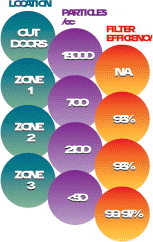
The data above show a wide range of differences in the building zones being commissioned. The filters were thus discovered in zone 2 to have leaks. The filters were changed with subsequent sample results being satisfactory.
 |
Andrew J. Streifel, MPH, REHS
For thirty years, Mr. Streifel, Hospital Environmentalist at the University of Minnesota Department of Environmental Health and Safety, has published and lectured extensively and served over 200 hospitals worldwide on air quality and patient care environments for solid organ and bone marrow transplant areas. Appointed to the Revision Task Force American Institute of Architects Guidelines for Construction of Hospitals, he assists industry leaders in design of critical care environments. |
For More Information Contact:
Bioscience International
11333 Woodglen Drive
Rockville MD 20852
Tel: 301-231-7400
Fax: 301-231-7277
Internet: BioInfo@Biosci-Intl.com